Groupsites are branded collaboration communities that empower groups of all types and sizes to communicate, collaborate and connect around a shared mission, organization, cause or company.
$99/month
All-inclusive
No per-user fees
Try FREE for 30 days
No credit card required
After free trial ends, 30 days notice prior to cancellation
epoc 4% Hematocrit Total Allowable Error validation
epoc 4% Hematocrit Total Allowable Error validation
Follow
23 followers
Like
0 Likes
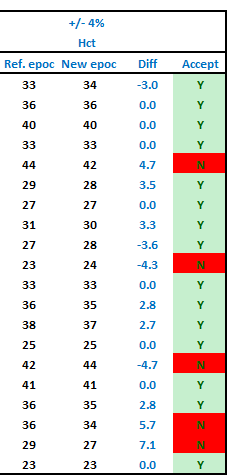
I'm trying to validate new epoc devices with an epoc device that we use as a reference but this can apply to when I also compare it to our hematology analyzer.
CLIA use to have a 6% total allowable error and recently it had changed to 4%.
I am running 20 samples for comparison, and I am getting less than 90% acceptable agreement between the devices. When it was 6%, I was able to easily get atleast 90% agreement. The numbers have to be exactly the same or just 1 percent difference to fall within the 4% total allowable error.
What is the total allowable error for hematocrit for everyone else?
Am I doing something wrong?
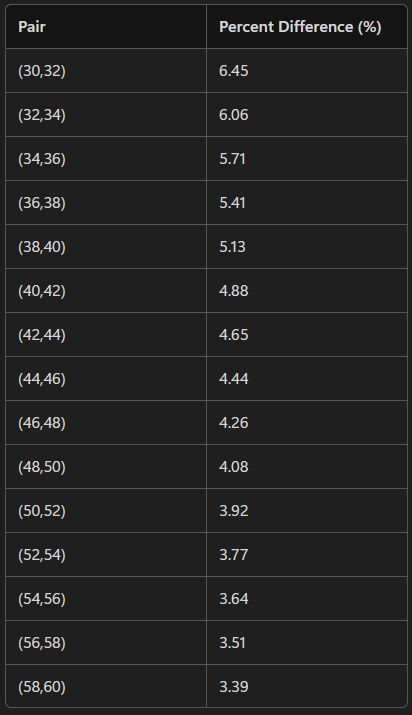
Below is a table of the results I got. The black table is just chatgpt table that shows what various pairs of numbers and their percent difference as an illustration.
We experienced the same issue with our Avox 1000E. As I understand it, the new CLIA 4% is for proficiency testing (PT). We kept failing PT so we discontinued the Hemoglobin on the Avox's until Werfen, the manufacturer, can address the issue. Have you experienced any PT failures? What does your manufacturer state to use for correlations? If the manufacturer range is higher than 4% I would think you would go with that and have your CLIA director approve.
Same issue here for the EPOC. We have not failed any PT, but the 4% for instrument correlations seems really tight. I don't know that Siemens gives a TAE for hematocrit comparisons, but I was going to adopt the 4%. I will have to talk to my pathologist about it since this seems almost unattainable in practice.
I believe the majority of us are ultimately going to have this issue. We have certainly already come across it several times and I have had conversations with several vendors regarding it. The first question the manufacturer will ask is "But is the difference medically significant?" Then after this they will state " The system is meeting the manufacturer specifications, it is performing within accepted tolerances." When you state that it is not meeting the new CLIA standards you will hear a lot of silence.
To summarize:
CLIA tightened the Total Allowable Error (TAE) on a number of tests.
The vendors have gone through the long and expensive of having their systems approved by the FDA, which includes total allowable error of said system. Modifying the TAE after the fact on these systems is going to create more cost and issues to meet tighter TAE.
We decided to have intra and inter device acceptability. Our director approved a higher TAE % when correlating across the different devices. Stayed 6% for those and then for ISTAT to ISTAT we use the 4%. It seems to have helped. That TAE is for PT testing so the medical director does not have to use that for comparability. We are all just used to using it that way though.
I agree with Miranda, the Medical Director can choose what acceptable limits they want to use. However, it's always good practice to be able to explain why you choose the limit. Here is a website with different acceptable limits that you can choose. Scroll down to Hematocrit and there are multiple organisation's (globally). https://www.google.com/amp/s/www.datainnovations.com/allowable-total-error-table/%3famp=1
Have you experienced any PT failures?
What does your manufacturer state to use for correlations? If the manufacturer range is higher than 4% I would think you would go with that and have your CLIA director approve.
To summarize:
We are caught in the middle.
https://www.google.com/amp/s/www.datainnovations.com/allowable-total-error-table/%3famp=1