Groupsites are branded collaboration communities that empower groups of all types and sizes to communicate, collaborate and connect around a shared mission, organization, cause or company.
$99/month
All-inclusive
No per-user fees
Try FREE for 30 days
No credit card required
After free trial ends, 30 days notice prior to cancellation
Horrible Luck: GEM 7000 Rounding Results for SO-B 2026
Horrible Luck: GEM 7000 Rounding Results for SO-B 2026
Follow
20 followers
Like
1 Likes
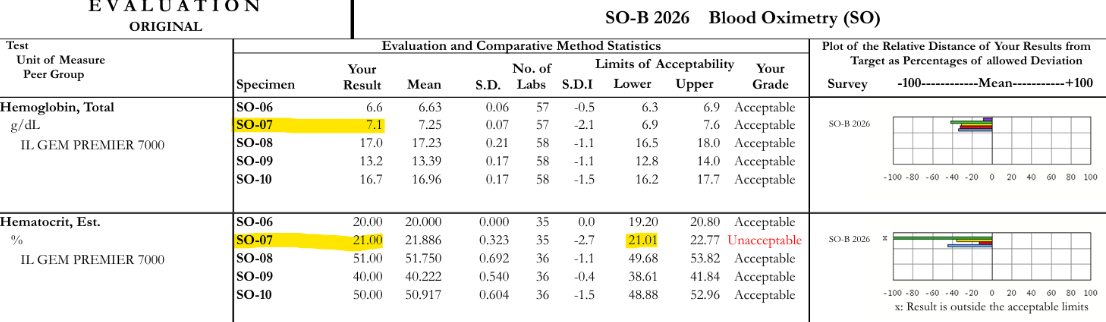
I just got my SO-B Blood Oximetry PT peer results back... I have the worst luck.
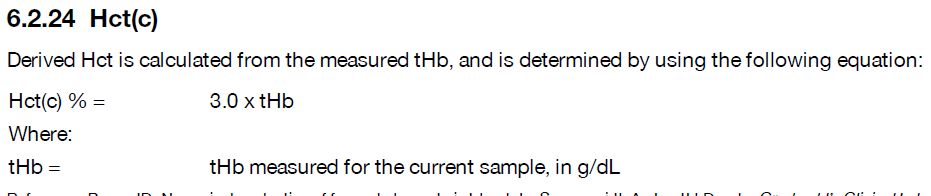
For our GEM 7000, hemoglobin is directly measured and hematocrit is calculated based on the hemoglobin result which is 3X the hemoglobin.
For SO-07 total hemoglobin results I got 7.1 g/dL. The hematocrit result (21%) was copied directly from the GEM 7000 printout. The lower acceptance limit is 21.01%.
Based on a manual calculation, the actual hematocrit value would be 7.1 x 3 = 21.3%. A hematocrit result of 21.3% would have been within the acceptable range.
The reported value appears lower because the GEM 7000 rounds results to whole numbers. The instrument settings do not allow decimal places to be displayed for hematocrit results.
I called CAP to figure out what to do in the future and they informed me that I have to input the result that is printed out from the analyzer.
I think this is rediculous. If all the peer group is using the GEM 7000 and you can't change the decimal places, the lower and upper range of 21.01 -22.77 should actually be 21 -23 to account for the rounding.
Due to the rounding, the reality of the range is actually tighter. For example, for the lower range of 21.01, you can only really get a calculation of 21.5 or more. If you get 21.4, The GEM will round you down so you are out because the lower limit is 21.01
Am I being unreasonable? that range is incredibly narrow.
I thought the total allowable error is 4% absolute for hematocrit. Shouldn't they just do plus/minus 4 off of the average to define lower and upper limits?
Did anyone else fail due to rounding from the GEM?
We had this happen on the Gem 5000 Cap told me they would make a case and review it in their clinical chemist meeting, but they did not tell me what the outcome was.
We don't report out the hematocrit on patients since it isn't a real value. Problem solved.
Even if the lower limit was 21.00 - to me you still have an issue with SO-07 based on the really low SDI value. Was that sample tested by a different end user than the rest? There's no prior history, is this a new instrument for you guys or were you using a different PT provider previously? Just curious if the negative bias was seen previously as well.
I agree with Kyle that you should investigate why all results are biased low. Were all 5 samples analyzed by the same user? If so, was it due to inadequate mixing? If they were analyzed by 5 different users, your calibration may not have been optimal.
@Don Tran and Kyle Nevins - Thank you for your reply. the 5 samples were analyzed by the same user. The instructions talked about mixing "vigorously", it was mixed, but I'm not sure what the definition of vigorously means to be honest. I will ask them to mix more harder next time to see if that helps.
In terms of bias, our quality cross check was evenly distributed but this PT looks different. I'm not sure how concerned I should be about the bias for this particular PT. SO 7 should be ignored due to the rounding. but overall, the hemoglobin and hematocrit trends lower than the average but not by a clinically significant margin. Am I wrong in saying this?
I'm not familiar with the GEM and am unsure of the calibration frequency. If calibration is straightforward, I would recalibrate the Hemoglobin. You can also perform a calibration verification for your write-up or justification. Since only one of the five is unacceptable, I'm not too concerned.
Cap told me they would make a case and review it in their clinical chemist meeting, but they did not tell me what the outcome was.
The limit is too narrow.
Even if the lower limit was 21.00 - to me you still have an issue with SO-07 based on the really low SDI value. Was that sample tested by a different end user than the rest? There's no prior history, is this a new instrument for you guys or were you using a different PT provider previously? Just curious if the negative bias was seen previously as well.
In terms of bias, our quality cross check was evenly distributed but this PT looks different. I'm not sure how concerned I should be about the bias for this particular PT. SO 7 should be ignored due to the rounding. but overall, the hemoglobin and hematocrit trends lower than the average but not by a clinically significant margin. Am I wrong in saying this?