Groupsites are branded collaboration communities that empower groups of all types and sizes to communicate, collaborate and connect around a shared mission, organization, cause or company.
$99/month
All-inclusive
No per-user fees
Try FREE for 30 days
No credit card required
After free trial ends, 30 days notice prior to cancellation
Absolute vs %Percentage: Hematocrit CLIA Total Allowable Error
Absolute vs %Percentage: Hematocrit CLIA Total Allowable Error
Follow
26 followers
Like
0 Likes
I remember seeing a post like this prior but I was searching the previous posts but I couldn't find it. My apologies for duplicate posts.
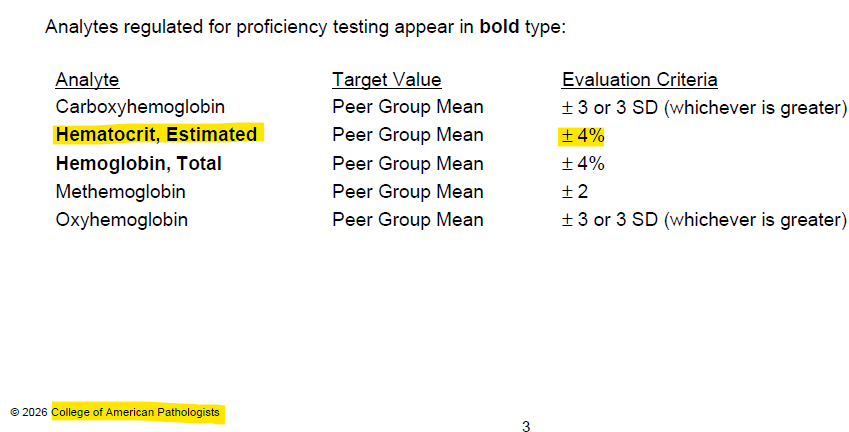
I just had a conversation with CAP about total allowable error for hematocrit. Hematocrit is expressed as a percentage unit.
They are saying that the total allowable error for hematocrit is +/- 4 percentage of the actual value. I have always interpretted and others have understood this as +/- 4 % (absolute); Hematocrit is already a percent and I'm interpreting the total allowable error as straightforward as possible.
For example, if the true value of the hematocrit is 20%: Based on %percent of the the percentage the lower and upper range would be 19.2% - 20.8% if based on absolute value, then the lower and upper range would be 16% - 24%
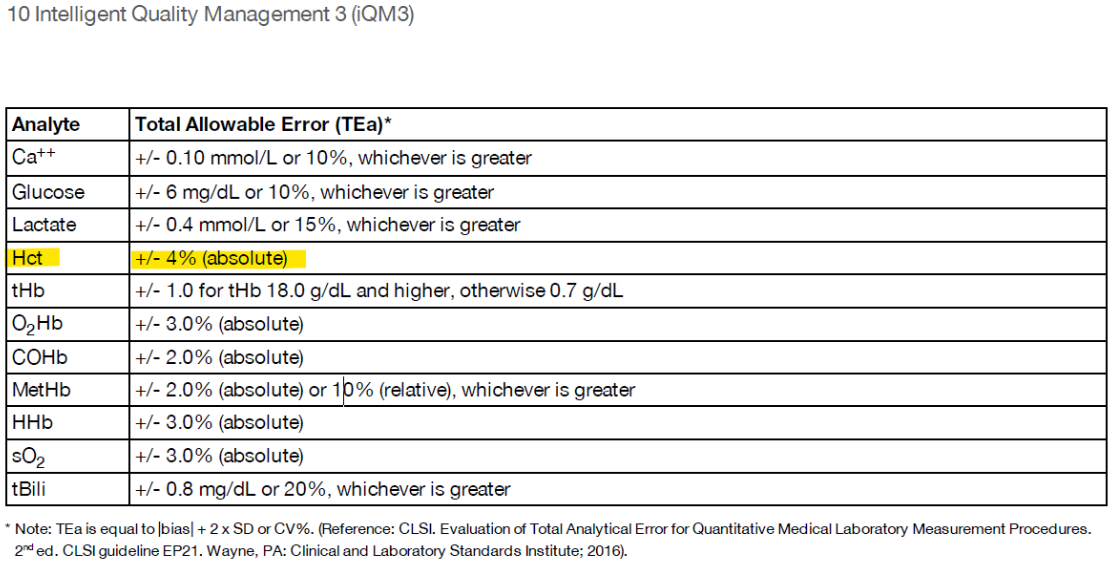
I was reading Werfen GEM 7000 manual and in the TEA section, it uses 4 % absolute. Werfen is not authoritative in interpretating this regulation but I just wanted to show the difference in understanding.
Is hematocrit +/- 4 percent or is it an absolute value? I may have to reach out to CMS for this.
I, for one, will be interested to hear what they say. I do not understand how they can place a performance limit - let alone a very narrow/restrictive limit - on a test that is not even directly measured - it is a calculated value. And the test, even when it IS directly measured, does not historically have the kind of precision that would lend itself to such a limit. Take iSTAT as an example, it is considered measured, not calculated, and for their Tricontrol QC, a mean target of 20 has an acceptable SD of 1.5 (absolute), so values from 17 to 23 would be considered still "in control". That is not a test that is going to perform well if the reproducibility expectation is 19.2 to 20.8%. In fact, looking at my last month's data points for iSTAT, using the range of 19.2 to 20.8, I would not have a single QC data point that is acceptable, out of 15. You cannot make an analyzer more precise than the manufacturer built it for. And even less so when the test is not directly measured and therefore has no assayed mean assigned by the manufacturer.
We have always used 4% (not absolute) because that is what is used on the CAP proficiency testing evaluation forms. We typically only use this when we are doing method comparisons.