Groupsites are branded collaboration communities that empower groups of all types and sizes to communicate, collaborate and connect around a shared mission, organization, cause or company.
$99/month
All-inclusive
No per-user fees
Try FREE for 30 days
No credit card required
After free trial ends, 30 days notice prior to cancellation
Verifying Reportable Range using Controls and Calibrators
Verifying Reportable Range using Controls and Calibrators
Follow
19 followers
Like
0 Likes
I am trying to expand the reportable range retrieved from the GEM 7000, but this question may apply to all types of instruments.
I was speaking to my lab director and informed her that we can use controls to span the range better. She informed me that you can't use controls to verify the range as it is not run under "patient mode" I have used calibration verification materials to verify reportable ranges and I have never run it under patient mode.
The point of verifying the reportable range is to see how high or low the device can go - the regulations never speak about requiring running the sample under patient mode specifically.
For our validation of the GEM 7000, we ran external linearity materials but the GEM 7000 also runs internal controls. I was wondering if that can be used to verify the reportable range but since my lab director is barring me from using controls, that idea can't be used.
Has anyone else heard of this idea that reportable ranges must be verified under patient mode? Am I wrong in thinking that QC material can be used to reach the low and high ends for the reportable range.
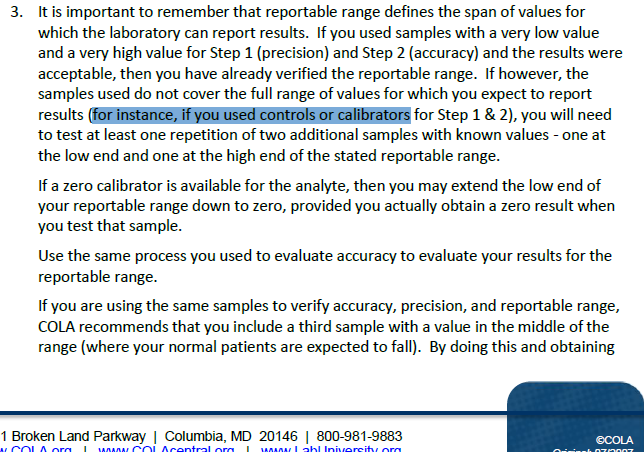
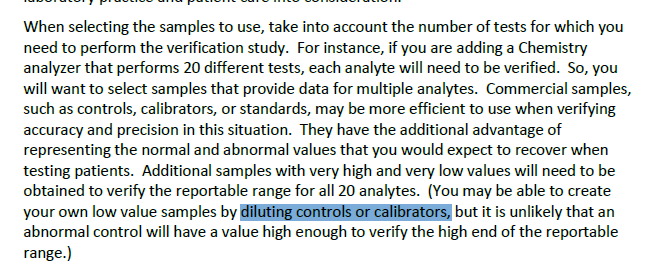
Below is a snapshot of COLA validation guidance. We are not COLA accredited but i like the document as it explicitly states it. The last image is just of the GEM internal liquid QCs.
Hi Jo, I just called CAP about this topic. See the CAP standard below. CAP shared you would need to define the stability for the analytes using the control material in procedure. This will be determined by the Medical Director. You could also use your Total Allowable Error if it applies. They also shared to put a statement in procedure the reason for choosing to use control material (calibrators do not span the range, etc). The standard #5 says, the control material needs to have method specific targets. CAP said I could control material that did not have method specific targets (i-STAT, GEMS, etc) if no other control material was available but it would have to be clearly defined in procedure along with acceptability criteria. Also, there was no mention of the validation needing to be tested in patient mode. Hope this helps.
@Lori Thank you so much. You are amazing for calling CAP, they are very helpful just like you.
so if Werfen GEM manual says the internal solution controls (PCSs) are "traceable to NIST Primary standards...These solutions are tonometered to specific values of pO2 and pCO2"
That essentially means that the internal control materials do have target values as seen on the chart and can be used for amr verification - is that correct?
I feel like I answered my own question but it is always nice to have other affirm that I'm not crazy. Thank you Lori.
I interpret method specific target values to mean the control material package insert specifically states a range for the GEMS, or a range for i-STAT, or a range for ABL analyzers, etc. If the control material you are using is specific for GEMS, then yes, I agree, you have method specific ranges. If the control material just lists one range, and it doesn't appear to be tested on different platforms, then I would say, it is not method specific. CAP said you can still use this, but you will need to provide a justification (no method specific quality control available) in your procedures.
I went back and looked at your original post. I think this statement I highlighted is perfect to prove the QC material is method specific. image.png
When you expand the reportable range beyond the manufacturer's recommendation, aren't you deviating from it? In that case, wouldn't it change the test complexity? Would non-lab personnel still be qualified to perform it? I would verify that with CAP first.
@Don Tran, I would not expand past the reportable range of the manufacturer's recommendation.
I would use the internal QC data (which they say are equivalent to external liquid qc) from the machine to verify the manufacturer's reportable range, thus not really changing the complexity.
Based on their document and the interpretation of the regulations, it looks like my stance is defendable.
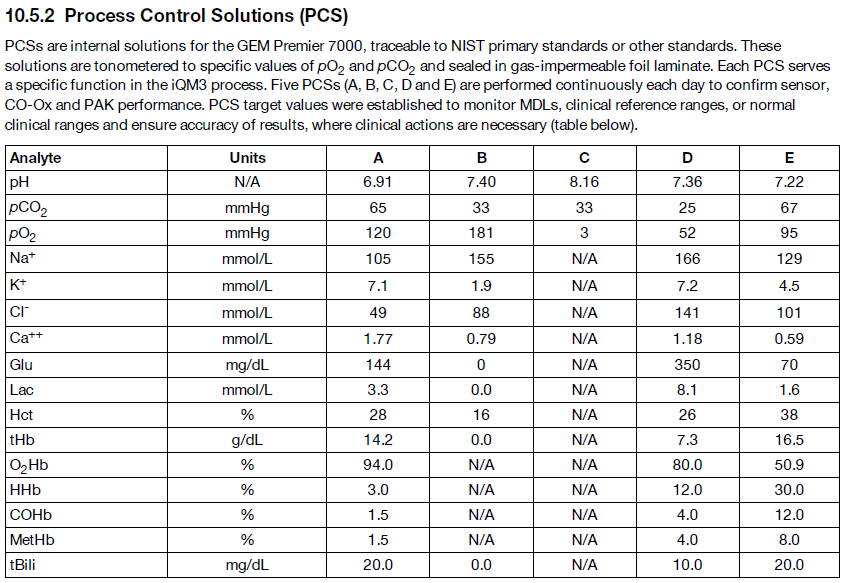
so if Werfen GEM manual says the internal solution controls (PCSs) are "traceable to NIST Primary standards...These solutions are tonometered to specific values of pO2 and pCO2"
That essentially means that the internal control materials do have target values as seen on the chart and can be used for amr verification - is that correct?
I feel like I answered my own question but it is always nice to have other affirm that I'm not crazy.
Thank you Lori.
I went back and looked at your original post. I think this statement I highlighted is perfect to prove the QC material is method specific.
I would use the internal QC data (which they say are equivalent to external liquid qc) from the machine to verify the manufacturer's reportable range, thus not really changing the complexity.
Based on their document and the interpretation of the regulations, it looks like my stance is defendable.